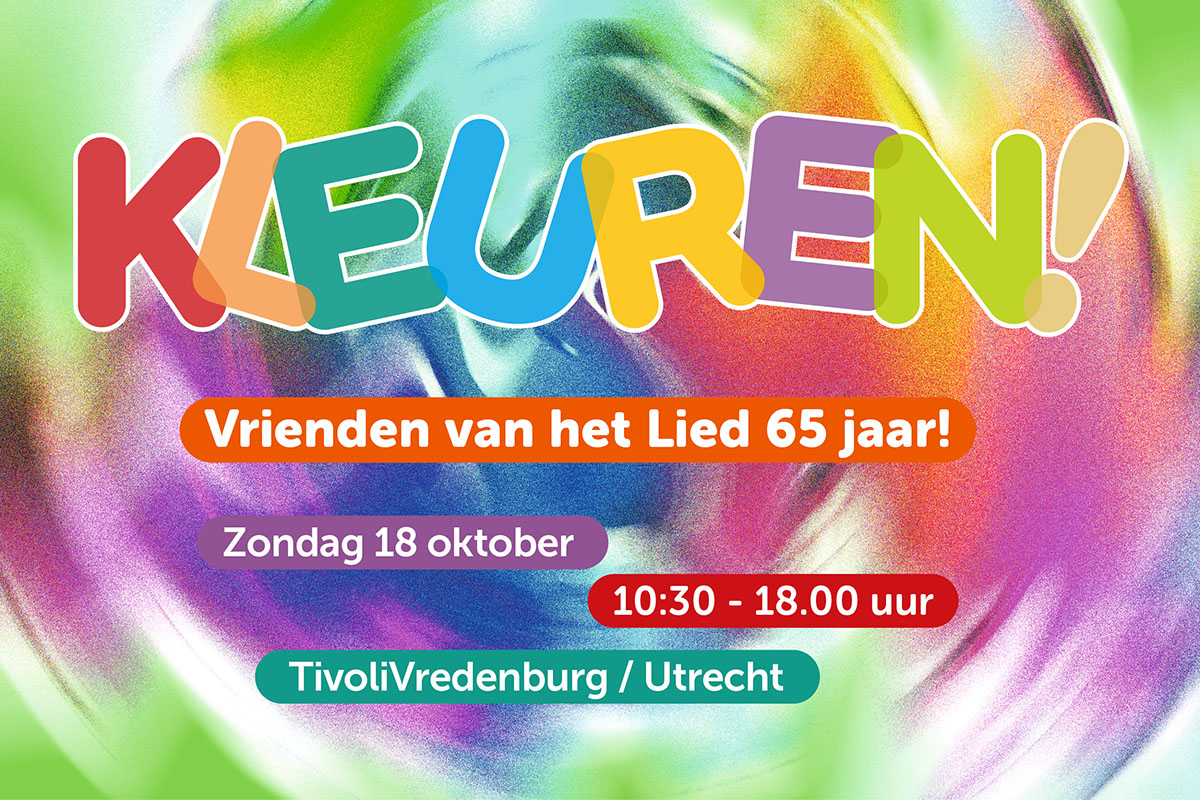
This autumn, we’re celebrating the founding of Vrienden van het Lied in 1961 with a festive anniversary event. On Sunday 18 October, TivoliVredenburg will be buzzing with lied. From half past ten until six o’clock, all sorts of activities will take place in the beautiful Hertz Hall, the main foyer and De Punt. The theme of the anniversary is Colours! Because the lied repertoire itself has many colours, just like the human voice. And we want to provide space for diversity and inclusion.
What you can expect on this day:
And of course, during the breaks there is ample opportunity to meet each other in the large foyer and afterwards to raise a glass to our society.
Admission feesmembers: €25.00 / non-members: €40.00 / < 30 years: €17.50
Members receive a £15.00 discount with the code they receive in the newsletter.
To redeem your discount code, follow all the steps in the ordering process. You can place an order with or without an account. The mandatory fields are marked with a red asterisk. At the bottom of the page where you enter your details, enter the code in the ‘discount code’ field. Do not forget to click ‘activate’ to apply the discount. Then complete the ordering process.
Prism of Song: From Morning Light to Cabaret Shadow
Lorraine Chan, soprano
Mathilde Herbaut, soprano
Aada Juvonen, soprano
Liselotte Sitters, mezzo-soprano
Coen Krimpenfort, baritone
Athanasia Kordi, piano
Felicia, piano
Hanna Summer Plague, piano
This programme explores the contrasting textures of light and shade, probing the expressive limits of the human voice. The musical arc takes the listener through a fragile emotional landscape: after the gold of a vibrating spring morning, plunging into the deep blue shadows of heartbreak, to finally invite them into the dark, theatrical underworld of 20th-century lied.
The journey begins in the Garden of Eden. In Heggies Snake is Eva confronted with temptation and forced to discover the true, sometimes harsh colours of the world. Smyth’s The Clown leads us deeper into the darkness of existence. Yet the work, even in the shadow, poses an essential question: can we find the lightness to keep dancing when our hands and feet are chained?
Next, we enter the brilliant light of the German lied. In Schubert's Ganymede does colour manifest in a warm, radiant glow that feels like love and nature close to one's heart. Strauss's’ Beating hearts enhances this mood with cheerful details: a golden sun, a shining ring and sparkling meadows sketch a sun-drenched landscape. Strauss's sparkling piano part and lively vocal line reflect the excitement of a young, loving heart, with the brilliance of the day reflecting the joy of living.
With their sights set on the south, Respighi's lied bring a completely different palette to the stage, bathing the hall in the warm, sun-drenched colours of the Tuscan countryside. In these two movements from Four Tuscan Respects do the rich, lyrical lines and lush piano part evoke the vibrant, golden hues of Italy. When you were born forms a radiant tribute to the dazzling beauty of a beloved, whilst It comes from far away paints a moving, pastoral picture of love and distance, imbued with an exhilarating Mediterranean warmth
As the daylight fades, a profound interplay of textures and shades emerges. Brahms’ The May Night depicts a nocturnal landscape in deep blue and dark green hues and the cold silver of the moon, thus capturing the melancholic colours of heartbreak. As a counterpart to this darkness, Barber introduces The Monk and His Cat the colour white: the white of the cat Pangur, the white of holy parchments. It is a colour of absolute purity, framing a simple, peaceful life bordering on the sacred.
The programme concludes in the smoky atmosphere of American lied. Bolcom's Song of Black Max introduces a mysterious, theatrical underworld surrounding Black Max: an enigmatic figure who is always dressed in black. Finally, Gershwin's classic Someone to Watch over Me the concert in a deep longing for security and emotional safety. The piece, written as a jazz ballad full of ‘blue notes’, evokes the soft, comforting colours of the night.
PROGRAM
Aada Juvonen & Hanna Zomerplaag
Jake Heggie
Snake (from Eve-Song, 1996)
Ethel Smyth
The Clown (from Three Songs no. 1, 1913
Lorraine Chan & Hanna Zomerplaag
Franz Schubert
Ganymed D 544 (1825)
Richard Strauss
Beating hearts (from: Three Lieder op. 29/2, 1895)
Mathilde Herbaut & Athanasia Kordi
Ottorino Respighi
When were you born?
3. It comes from way over there
(from: Four Tuscan Respects 1915)
Coen Krimpenfort & Athanasia Kordi
Johannes Brahms
The May Night (from Four Songs op. 43/2, 1857)
Samuel Barber
The Monk and His Cat (from Hermit Songs op. 29/8, 1953
Liselotte Sitters & Felicia
William Bolcom
Song of Black Max (from: Cabaret Songs, 1978)
George Gershwin
Someone to Watch over Me (1926)
Let the Florid Music Praise!
Francis van Broekhuizen, soprano
Femke de Graaf, piano
Like Vrienden van het Lied, Francis and Femke are also celebrating an anniversary this year. “We became a duo in 2001 and worked together towards our first major concert: Francis's bachelor's final exam in classical singing at the Conservatorium van Amsterdam. We opened that concert with Let The Florid Music Praise! by Britten. We also had Tchaikovsky's lied on the programme then and Hedgehog's Cradlelied, for which we have written a second vocal part for the occasion. We thought the theme of friendship was a lovely one to incorporate into this programme in honour of the VvhL's anniversary.”
In connection with the theme COLOURS! have Francis and Femke programmed many composers with an LGBTQ+ background? And of course they wanted to give a platform to women, including a black woman (Florence Price).
Catharina van Rennes is a composer from Utrecht and a line of poetry from her famous Sun lied is written on her memorial plaque on the façade of her home and singing school in Brigittenstraat in Utrecht. That line reads Faithfulness will keep our heart, Despite rain and storms.
Furthermore, the presence of many different languages is colourful.
PROGRAM
Benjamin Britten (1913-1976)
Let the Florid Music Praise! (no. 1 from On this Island, op. 11; Auden
Benjamin Britten (1913-1976)
from: Cabaret songs (Auden)
Funeral blues
Johnny
Calypso
Florence Price (1887-1953)
End of travel Folwell Hoisington
Ethel Smyth (1858-1944)
Possession (no. 2 from Three Songs; Carnie Holdsworth
Pyotr Ilyich Tchaikovsky (1840-1893)
My genius, my angel, my friend (Fet)
Pyotr Ilyich Tchaikovsky (1840-1893)
Not only the one who knew(No. 6 of 6 Romances, Opus 6; May after Goethe)
Henrietta Bosmans (1895-1952)
This island (No. 3 from Terugblik; Roland Holst)
Francis Poulenc (1899-1963)
Pray for peace (d'Orléans)
Catharina van Rennes (1858-1940)
Sun lied (No. 1 of 3 Liederen opus 8; Bottle)
Paul Christiaan van Westering (1911-1991)
Hedgehog's Cradlelied (Schmidt)
break
Winter Metamorphosis
Darta Liepina, soprano
Enrico Clerico, piano
This programme begins in the muted colour palette of late autumn and deep winter: Respighi's mist, Berg's wind-swept reeds and Debussy's shadowy river landscape give way to the anxiety and psychological silence of Rihm and Mahler-Schindler. In this context, the arrival of snow is not a symbol of death, but of transformation through its light. Stravinsky's arrangements of three Japanese haikus draw upon a recurring image in the lied tradition: the resemblance between snowflakes and blossoms. Yet snow proves to be even more powerful. Its cold can set a heart ablaze in Ravel's Marot setting, while the white landscape gradually gives way to the first spring colours in Schumann, Wolf and Schubert.
PROGRAM
Ottorino Respighi (1879-1936)
Nebbiolo (Negri)
Alban Berg (1885-1935)
Reed lied (No. 2 of 7 early Lieds; Lenau)
Claude Debussy (1862-1918)
The shadow of the trees (No. 3 from Ariettes oubliées; Verlaine)
Wolfgang Rihm (1952-2024)
Do you love the dark (No. 6 from Das Rot; by Günderrode)
Alma Mahler (1879-1964)
Light in the night (no. 1 of 4 Lieder; Bierbaum
Igor Stravinsky (1882-1971)
Three Japanese Lyrics (Russian translation by Brandt)
Akahito
Mazatsumi
Tsaraiuki
Maurice Ravel (1875-1937)
To Anne, who threw snow at me (No. 1 from Épigrammes by Clément Marot)
Robert Schumann (1810-1856)
Snowdrop (No. 27 from Liederalbum für die Jügend op. 79; Rückert)
Hugo Wolf (1860-1903)
Snowdrops (no. 4 of 6 Lieder by Robert Reinick)
Franz Schubert (1797-1828)
Spring Faith D 686 (Uhland)
lunch break
Following the announcement of an open stage dedicated to Benjamin Britten, applications poured in and we had to put up the ‘fully booked’ sign in no time. On 18 October, twelve amateur singers and five amateurliedaccompanists will present a colourful selection from the extensive liedwork of this British composer, who passed away 50 years ago, for two hours: folk song arrangements, Cabaret Songs and excerpts from various liedcycles. The singers without their own pianist can count on fantastic accompaniment from Femke de Graaf and Bas Verheijden.
Each duo is in the spotlight for about eight minutes in De Punt. And, of course, non-singing members are very welcome too, because what is an open mic without an audience?!
lunch break
Schubert transcriptions
Bas Verheijden, pianist
Pianist Bas Verheijden has been working on transcriptions of liederen for years, and particularly on those of Schubert. He will play a number of transcriptions in which he makes the piano sing and showcases Schubert's sound painting. In between, Bas will explain how he has integrated the lyrics and vocals into the piano part. That calls for a pianist with a rich palette of colours!
Henriette Feith is in conversation with the world-renowned tenor Christoph Prégardien, who is also a member of our honorary committee, about his life as a singer and his impressive career. For instance, between 1990 and 2000, he was a regular soloist with the Amsterdam Baroque Orchestra & Choir, conducted by Ton Koopman. A large number of Dutch singers who were in the choir at that time, including Henriette herself, experienced him at close quarters as both a singer and an exceptionally congenial colleague.
Henriette: ‘I think it's a great honour to interview him, and secretly I find it a little bit awe-inspiring too! Fortunately, questions from the floor will also be able to be asked, so we're doing it together a little bit after all. I'm looking forward to it!’
break
Tenor Christoph Prégardien is not only a world-famous tenor, he is also a member of our honorary committee! During the masterclass he will coach two student duos from the Conservatorium van Amsterdam:
Maria Bastos, soprano
Jana Schell, piano
Claude Debussy (1862-1918)
Green (No. 5 from Ariettes Oubliées; Verlaine)
Clara Schumann (1819-1896)
I was in dark dreams (from: 6 Liedis op. 13)
Harry Gant, tenor
Jana Schell, piano
Robert Schumann (1810-1856)
I was walking among the trees (from: Liederkreis on. 24/3 / Heine)
Franz Schubert (1797-1828)
That ugly color (from: Die schöne Müllerin D 795/17 / Müller)
Following the announcement of an open stage dedicated to Benjamin Britten, applications poured in and we had to put up the ‘fully booked’ sign in no time. On 18 October, twelve amateur singers and five amateurliedaccompanists will present a colourful selection from the extensive liedwork of this British composer, who passed away 50 years ago, for two hours: folk song arrangements, Cabaret Songs and excerpts from various liedcycles. The singers without their own pianist can count on fantastic accompaniment from Femke de Graaf and Bas Verheijden.
Each duo is in the spotlight for about eight minutes in De Punt. And, of course, non-singing members are very welcome too, because what is an open mic without an audience?!
break
Soul Prism
Elenora Hu, soprano
Amy Chang, piano
What is beheld through glass seems glass.
The quality of what I am,
Encases what I am not,
Smooths the strange world.
I perceive it slowly
In my time,
In my material,
As my pride,
As my possession:
The vision is love.
When life crashes like a cracked pane,
Still shall I love
Even the slight grass and the patient dust.
Death also sees, though darkly,
And I must trust then as now
Only another kind of prism
Through which I may not put my hands to touch.
Prisms Laura Riding Jackson (1901-1991)
What do we truly see, and what only through the glass through which we look? In the anniversary programme Soul Prism becomes the soul a prism: a fracture plane in which emotions, memories and desires unfold into a rich spectrum of colours. Inspired by Laura Riding Jackson’s poem Prisms does this programme explore how perception is always coloured – personal, changeable and elusive.
Colours are not only a visual image, but also an inner experience. Sometimes light and fleeting, like a glimpse of something playful; sometimes saturated and intense, as an emotion that cannot be hidden. This continuous movement between stillness and exuberance, between transparency and depth, is rarely captured as strikingly as in lied art.
Sound becomes glow, text becomes shadow, and meaning arises precisely in that refraction: where one merges into the other. What first seems clear takes on a new hue; what was hidden suddenly catches the light.
To mark the 65th anniversary of the Friends of Song Amy Chang and I (Elenora) warmly invite you to surrender to that multicolouredness along with us: to wander, to associate, and perhaps to recognise something of yourself in the reflections. Just as a prism adds no colour, but makes visible what is already there, music reveals a world that was always present, waiting to be seen and heard.
Elenora Hu 2026
PROGRAM
María Rodrigo (1888-1967)
The night is serene (no. 2 from Ayes; by O. Lejárraga García)
Poldowski (1879-1932)
Columbine Verlaine
Augusta Holmès (1847-1903)
Les Heures (Holmès)
The Pink Hour
The Golden Hour
The Hour of Purple
The Azure Hour
Rosy Wertheim (1888-1949)
Scherzo Dark
Clara Schumann (1819-1896)
Six Lieder opus 13
I stood in dark dreams (Heine
They both loved each other (Heine)
love spell (Geibel)
The moon comes stealing quietly (Geibel)
I have in your eye (Rückert)
The silent lotus flower (Geibel)
Cécile Chaminade (1857-1944)
Hat Guinand
Loving Sylvester
Villanelle Guinand
Summer Guinand
Afterglow with drinks and a meet-and-greet with the musicians.
With thanks to:


thanks to the Cultural Fund, and in part thanks to the Emmelot Vis Fund
| Cookie | Duration | Description |
|---|---|---|
| cookielawinfo-checkbox-analytics | 11 months | This cookie is set by GDPR Cookie Consent plugin. The cookie is used to store the user consent for the cookies in the category "Analytics". |
| cookielawinfo-checkbox-functional | 11 months | The cookie is set by GDPR cookie consent to record the user consent for the cookies in the category "Functional". |
| cookielawinfo-checkbox-necessary | 11 months | This cookie is set by GDPR Cookie Consent plugin. The cookies is used to store the user consent for the cookies in the category "Necessary". |
| cookielawinfo-checkbox-others | 11 months | This cookie is set by GDPR Cookie Consent plugin. The cookie is used to store the user consent for the cookies in the category "Other. |
| cookielawinfo-checkbox-performance | 11 months | This cookie is set by GDPR Cookie Consent plugin. The cookie is used to store the user consent for the cookies in the category "Performance". |
| viewed_cookie_policy | 11 months | The cookie is set by the GDPR Cookie Consent plugin and is used to store whether or not user has consented to the use of cookies. It does not store any personal data. |
 Dutch Dutch Dutch
  English Dutch Dutch Dutch English