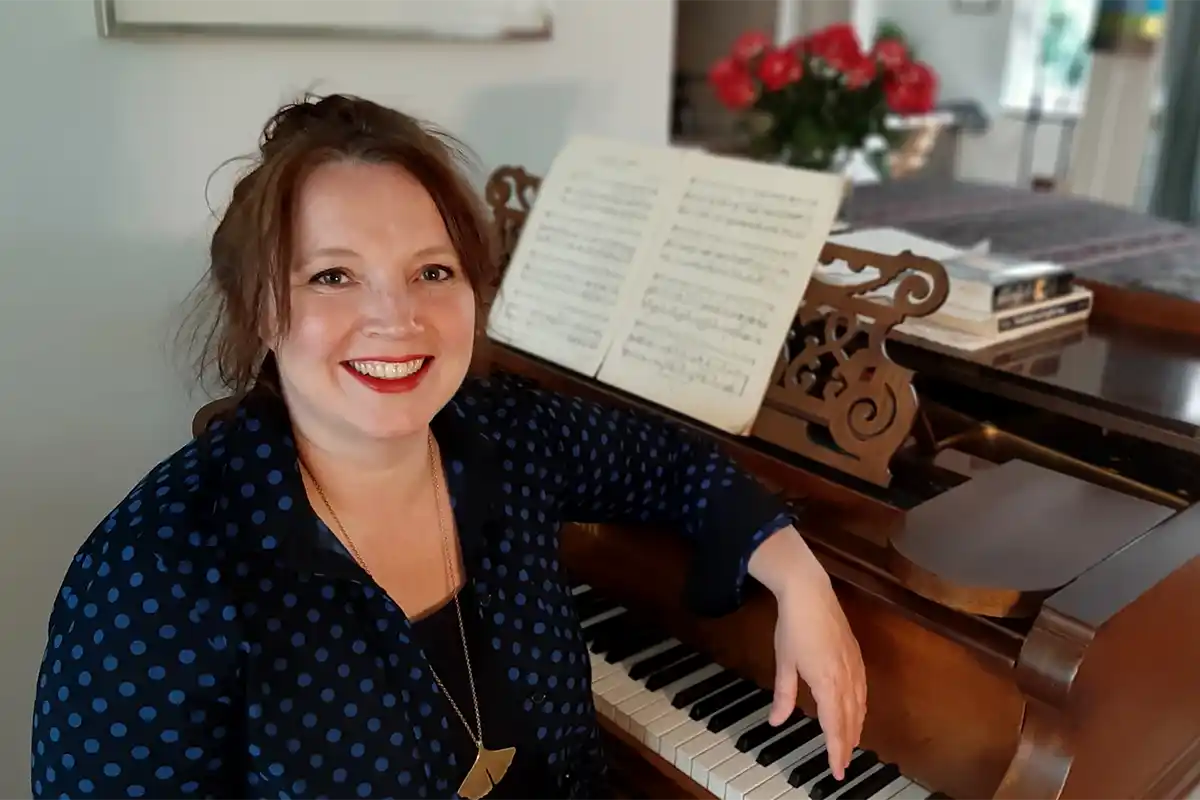
What would you like to give or recommend to young duos?
Keep listening openly to each other. Song art does not arise from a soloistic attitude but through playing together, breathing together, colouring together, searching together for what the text wants to say in the music. Be patient, a duo grows towards each other through trust, by daring to be critical, curiosity, shared imagination, by inspiring each other and by gathering as much stage experience as possible. First and foremost is the music, therefore always ask yourself what that one song means to you.
What makes a song recital really special to you?
For me, a recital becomes really special when singer and pianist find one common breath and become together as one narrator of the music's story. Attention to silence is also important to me. Attentive silence between songs creates a field of tension, like a prelude to what is yet to come. Then, as a listener, you are drawn to the stage. And of course the programme: a recital programme is in itself a composition: it appeals to me most when groups of songs or stand-alone songs have a clear connection with each other to tell a strong story. A voice or piano playing can be technically beautiful, but it is nowhere without the power of the story.
Can you remember a recital that really impressed you? What made it so unforgettable?
A recital with the Songs and Dances of Death by Mussorgsky, songs by Tchaikovsky and War Scenes of Ned Rorem by pianist Julius Drake and bass-baritone Gerald Finley at the Concertgebouw Amsterdam.
It was a technically impressive, and emotionally intense programme. The programme began with ultimate romantic songs by Tchaikovsky, which Gerald Finley sang beautifully lyrically over Julius Drake's legato piano playing. Then came Mussorgsky, the mood darkening, a macabre drama with growling fortissimo and enchanting pianissimo from Julius Drake. There was a very concentrated atmosphere in the hall. Then insanely impressive songs by Ned Rorem.
I thought it was a very powerful and special programme, performed so fantastically by these grandiose musicians, that I was breathless for a while afterwards.
How do you see the future of classical song within the new generation of singers?
It is very good to keep thinking about the function and meaning of song art as an art form. What do you actually want it to express? I think that, like any form of expression, a song recital can also be a mirror for the listener, a form to reflect on what the content triggers in the viewer or listener. If there is movement in the world, it expresses itself in art. And there is so much in motion these days.
I see a lot of openness and curiosity in young singers. With the accessibility of social media, there is a lot of repertoire to discover, you can connect with practically anyone and exchange knowledge.
The new generation of singers dares to be personal and look for what the song can mean now, in their own time, by searching for what really sets them apart, for example, by partnering with other art forms, incorporating into the programme the themes of our society, or so many other ways.
I find that hopeful, the song remains something so alive and keeps moving that way.
Why do you think it is important that (young) singers continue to discover and perform song repertoire?
For singers and pianists alike, the discovery you have made yourself is your own musical treasure; a treasure is something you cherish and display as something precious.
If you see the song as a form of expression for the underlying story (think Schubert's Winterreise), then you realise that it is an indispensable tool for your message in a programme. Your singing voice or piano playing is ‘only’ the narration. You have gained this knowledge by sleuthing, the listener only gets one moment to hear it. So it is important to keep exploring what can make your personal story ironclad.
The song repertoire is so rich and extensive, discovering something new keeps you sensitive and curious. Every poet, every composer brings something along that makes you keep growing, both musically and technically, you keep immersing yourself in composers and poets, history, and so on. The search for song repertoire and immersing yourself in it is endless, that sleuthing gives me great pleasure and is essential to me. By exploring, the music becomes more and more a piece of yourself.
What are your top three favourite songs at the moment?
I find naming favourite songs almost impossible. There are so infinitely many beautiful ones. Right now I'm thinking of these three, tomorrow probably different ...
Love bade me welcome from Five Mystical Songs by Ralph Vaughan Williams
Ich bin der Welt abhanden gekommen by Gustav Mahler on a poem by Friedrich Rückert
Des Baches Wiegenlied from Die schöne Müllerin by Franz Schubert
| Cookie | Duration | Description |
|---|---|---|
| cookielawinfo-checkbox-analytics | 11 months | This cookie is set by GDPR Cookie Consent plugin. The cookie is used to store the user consent for the cookies in the category "Analytics". |
| cookielawinfo-checkbox-functional | 11 months | The cookie is set by GDPR cookie consent to record the user consent for the cookies in the category "Functional". |
| cookielawinfo-checkbox-necessary | 11 months | This cookie is set by GDPR Cookie Consent plugin. The cookies is used to store the user consent for the cookies in the category "Necessary". |
| cookielawinfo-checkbox-others | 11 months | This cookie is set by GDPR Cookie Consent plugin. The cookie is used to store the user consent for the cookies in the category "Other. |
| cookielawinfo-checkbox-performance | 11 months | This cookie is set by GDPR Cookie Consent plugin. The cookie is used to store the user consent for the cookies in the category "Performance". |
| viewed_cookie_policy | 11 months | The cookie is set by the GDPR Cookie Consent plugin and is used to store whether or not user has consented to the use of cookies. It does not store any personal data. |
 Dutch Dutch
  English Dutch Dutch English