You auditioned in January. What made Vrienden van het Lied so appealing to you that you decided to audition?
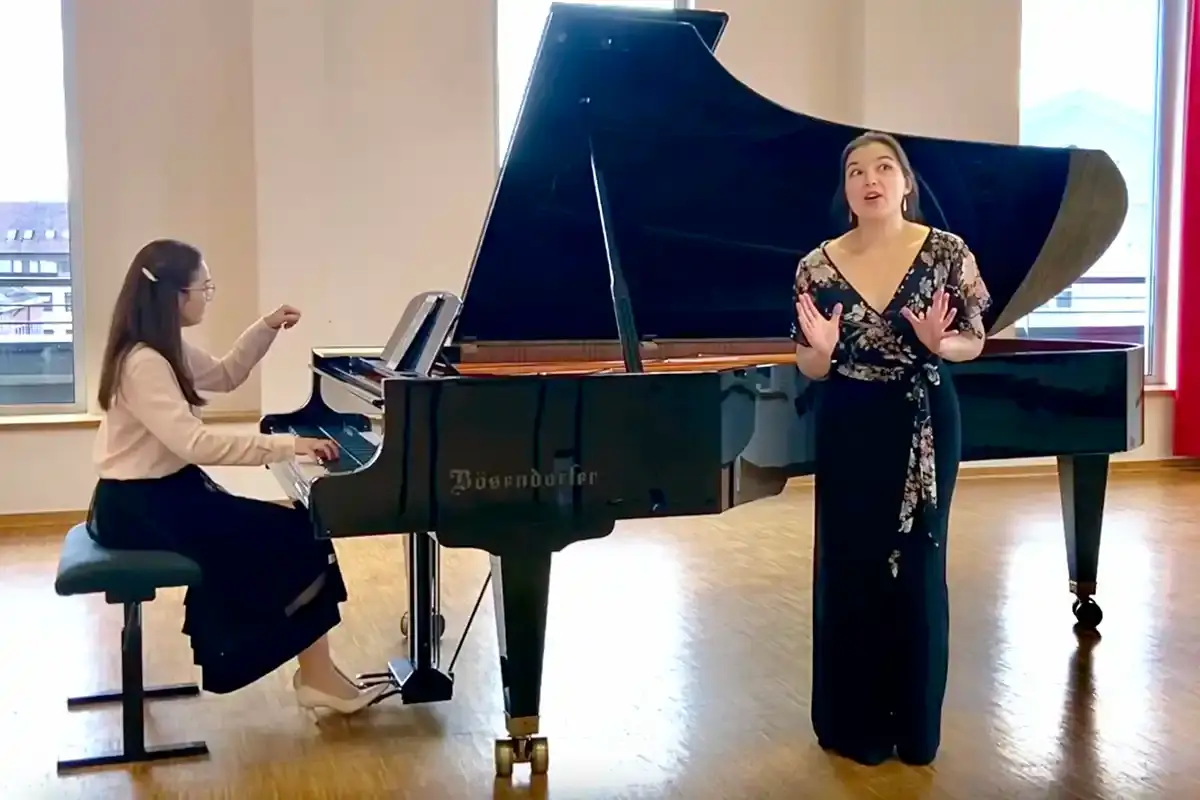
‘As a lied duo, we are always looking for opportunities to perform our lied repertoire, share our musical vision and artistic identity, and connect with audiences. Vrienden van het Lied offers precisely such a platform, which made the audition particularly appealing to us. It felt like a natural step: a chance to present our work to a broader audience and share our passion with people who share our love for the art of lied. We also saw it as a wonderful opportunity to develop further as a lied duo and to become part of a community that cherishes and supports the lied repertoire.’
What kind of music makes your heart beat faster? Who or what is your source of inspiration?
Julia: ‘For me, the answer is actually very simple: the music of Brahms. Of all composers, he is the one I always return to, both for his lied and for his solo works. In addition, my heart always beats faster when I discover something special in the repertoire of female composers. I can then not wait to share that music with the audience. Recently, the lied by Rebecca Clarke and Kaija Saariaho were such discoveries for me.’
At what moment were you gripped by lied?
Julie: ‘My love for lied was born from a series of encounters with inspiring musicians and with the repertoire itself. When I began to discover these works, I was struck by the unique intimacy between music and text. I discovered how much depth and refinement is hidden in these pieces and how a single line of poetry can evoke a whole world of feelings and meanings. What I also find so special about the lied repertoire is the close relationship between voice and piano: an interplay based on listening, trust, exchange, openness and flexibility. Creating that musical interplay is precisely something that I love enormously. For me, the most beautiful moments on stage arise when singer and pianist completely trust and are open to each other, so that the music can come to life in a spontaneous and authentic way.’
How do you as musicians deal with nerves?
Julie: ‘Instead of fighting my nerves, I try to listen to them and channel them into positive energy. As a result, I no longer dread the performance, but actually look forward to taking to the stage. A different way of thinking has helped me enormously with this. I don't necessarily try to deliver a “perfect” performance; I simply want to give the best of myself, as an artist and as a human being, while remaining open to what is happening within me and around me at that moment. I try to stay connected to the music and to the audience. Ultimately, a concert is a human encounter, and that is precisely what makes live performances so special.’
After a recital, the audience heads home again. What are you hoping they take with them?
‘We hope that our recital takes the audience on an emotional journey, allowing a wide range of feelings to pass by: from humour and joy to melancholy and introspection. With colourful and varied programmes, we want to appeal to their emotional world and stimulate their imagination. We also hope that our performance gives rise to new discoveries, for example of the wonderful liederen by female composers, who occupy an important place in our repertoire. Above all, we hope that the audience experiences the same wonder and enthusiasm that we felt when we got to know these special works. If people leave the hall feeling that they have discovered something new, have been inspired, and feel more connected to themselves, to others and to the emotions that connect us all, then we have achieved what we set out to achieve.’
If you could talk to a deceased composer, who would it be and what would you want to talk about?
Julia: ‘I often think about how special it would be to be able to talk to Brahms. I keep discovering new things in his music and constantly asking myself all sorts of questions. I think our conversation would be primarily philosophical in nature. And of course I would also ask him that one question everyone is curious about: did Clara love him too?’
What does Vrienden van het Lied mean for young musicians like you?
‘For young musicians with a passion for the lied repertoire, Vrienden van het Lied offers precisely what matters most to us: the opportunity to share our music with others and build a connection with the audience. In addition, we are given the valuable chance to put together concert programmes, explore meaningful themes and further develop our artistic ideas as a duo. Preparing and rehearsing forms a major part of our lives, and we thoroughly enjoy devoting ourselves entirely to that which is our passion.’
Julie and Julia are running their programme Histoires naturelles things to do in the Utrechtse Heuvelrug region:
Sunday 4 October / 15:00 / Zeist
| Cookie | Duration | Description |
|---|---|---|
| cookielawinfo-checkbox-analytics | 11 months | This cookie is set by GDPR Cookie Consent plugin. The cookie is used to store the user consent for the cookies in the category "Analytics". |
| cookielawinfo-checkbox-functional | 11 months | The cookie is set by GDPR cookie consent to record the user consent for the cookies in the category "Functional". |
| cookielawinfo-checkbox-necessary | 11 months | This cookie is set by GDPR Cookie Consent plugin. The cookies is used to store the user consent for the cookies in the category "Necessary". |
| cookielawinfo-checkbox-others | 11 months | This cookie is set by GDPR Cookie Consent plugin. The cookie is used to store the user consent for the cookies in the category "Other. |
| cookielawinfo-checkbox-performance | 11 months | This cookie is set by GDPR Cookie Consent plugin. The cookie is used to store the user consent for the cookies in the category "Performance". |
| viewed_cookie_policy | 11 months | The cookie is set by the GDPR Cookie Consent plugin and is used to store whether or not user has consented to the use of cookies. It does not store any personal data. |
 Dutch Dutch Dutch
  English Dutch Dutch Dutch English