As a lied enthusiast, you naturally also sing a lied from time to time. Who knows, you might be accompanied by a pianist. Sometimes the piano part is an arrangement of an orchestral accompaniment. Or... you might have yourself accompanied in Franz Schubert's An die Musik by a guitar with a recorder. In that case, you are making use of a so-called transcription.
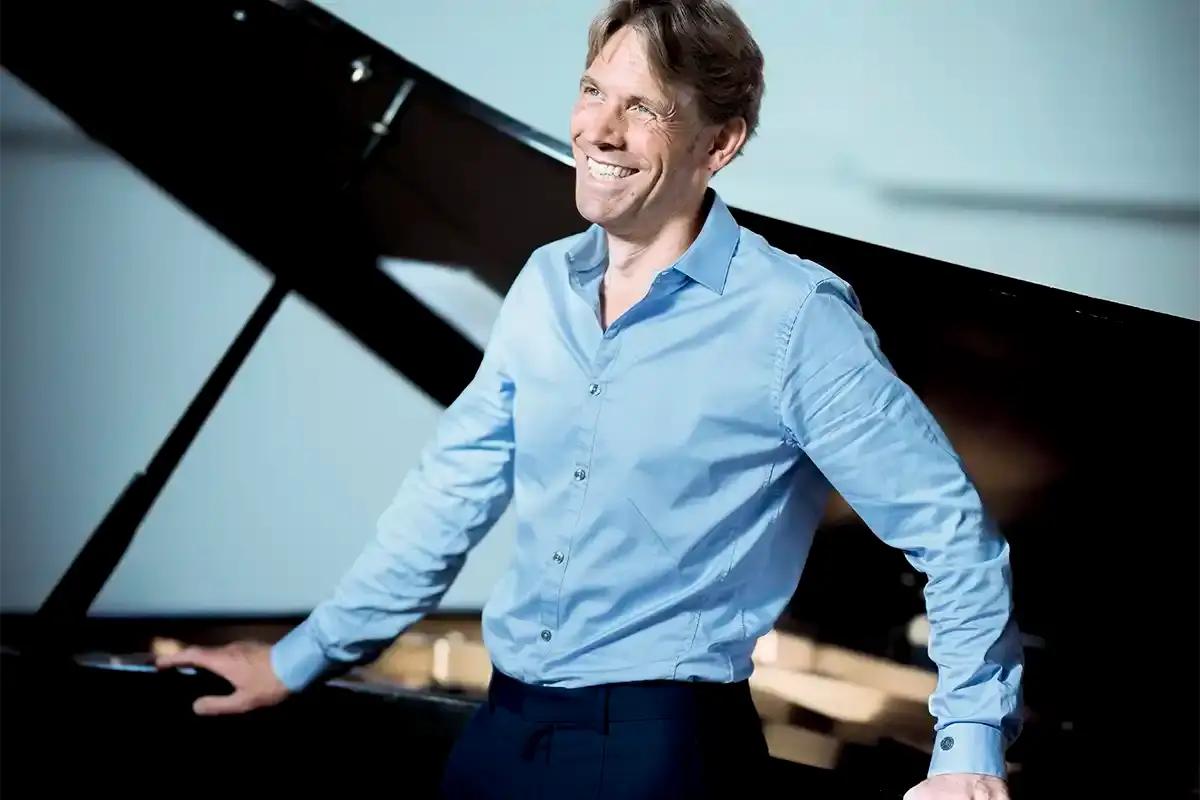
Transcriptions have become a speciality of pianist Bas Verheijden. With his Atlantic Trio (piano, violin and cello) he once accompanied his musical partner Maarten Koningsberger in Beethoven's well-known Scottish and Irish lieds, which were originally written for voice and piano trio. The collaboration was successful and left them wanting more. Therefore, Bas began adapting more lieds for accompaniment by a piano trio, a combination for which not all that many arrangements exist. Through his dedication and craftsmanship, a long list of transcripties of lieds by various composers was created. Truly a treasure trove of material for the world of chamber music. And a wonderful CD was released: Night and Dreams. Schubert's Lied, arranged by Bas for baritone and piano trio. ‘As if they flowed from Schubert's own pen,’ wrote the Nederlands Dagblad of Bas's transcriptions. And in Opium Klassiek, Aart van der Wal is full of praise for Bas's piano playing and arrangements, calling him: ’A true Schubertian through and through.’
But on 18 October you are taking to the stage alone, Bas?
That's right. On the anniversary day, I will talk about my Schubert lied for solo piano. With Maarten Koningsberger, I spent a very long time working intensively on Schubert, of course. Schubert has truly become my hero, my favourite lied composer. When I was 15, I heard Jorge Bolet play Liszt transcriptions on his Baldwin grand piano. That wonderful, transparent and singing tone became my ideal. Now I have a Baldwin concert grand of my own, and I am constantly searching for that same singing quality in my arrangements and in my performance of them.
Don't you quickly lose a lot of the expressive piano accompaniment in such an arrangement?
That is indeed the challenge: not to make a technical exercise out of those transcripties, but to bring out the sound painting. And I emphasise that you can hear precisely that completely unique language of Schubert's accompaniments in my transcriptions.
Do you remember which lied you chose to transcribe first?
Schubert's Romanze D 797 was my first and that went quite smoothly, but after that it became a real struggle of course, just think of a lied like On the Bruck D 853 …
Were you inspired by Liszt's achievements in this area? Or by Mendelssohn's? Lieder without words perhaps?
You can notice with Mendelssohn that they are thoroughly pianistic works, a big difference. Liszt is of course a master, a great role model. Just like Liszt, I want to show how beautifully a piano can sing. So that I don't have to do it myself, because I wouldn't be doing the world any favours with that … !
Francine van der Heijden
Listen to Bas Verheijden's transcriptions on Spotify:
| Cookie | Duration | Description |
|---|---|---|
| cookielawinfo-checkbox-analytics | 11 months | This cookie is set by GDPR Cookie Consent plugin. The cookie is used to store the user consent for the cookies in the category "Analytics". |
| cookielawinfo-checkbox-functional | 11 months | The cookie is set by GDPR cookie consent to record the user consent for the cookies in the category "Functional". |
| cookielawinfo-checkbox-necessary | 11 months | This cookie is set by GDPR Cookie Consent plugin. The cookies is used to store the user consent for the cookies in the category "Necessary". |
| cookielawinfo-checkbox-others | 11 months | This cookie is set by GDPR Cookie Consent plugin. The cookie is used to store the user consent for the cookies in the category "Other. |
| cookielawinfo-checkbox-performance | 11 months | This cookie is set by GDPR Cookie Consent plugin. The cookie is used to store the user consent for the cookies in the category "Performance". |
| viewed_cookie_policy | 11 months | The cookie is set by the GDPR Cookie Consent plugin and is used to store whether or not user has consented to the use of cookies. It does not store any personal data. |
 Dutch Dutch Dutch
  English Dutch Dutch Dutch English