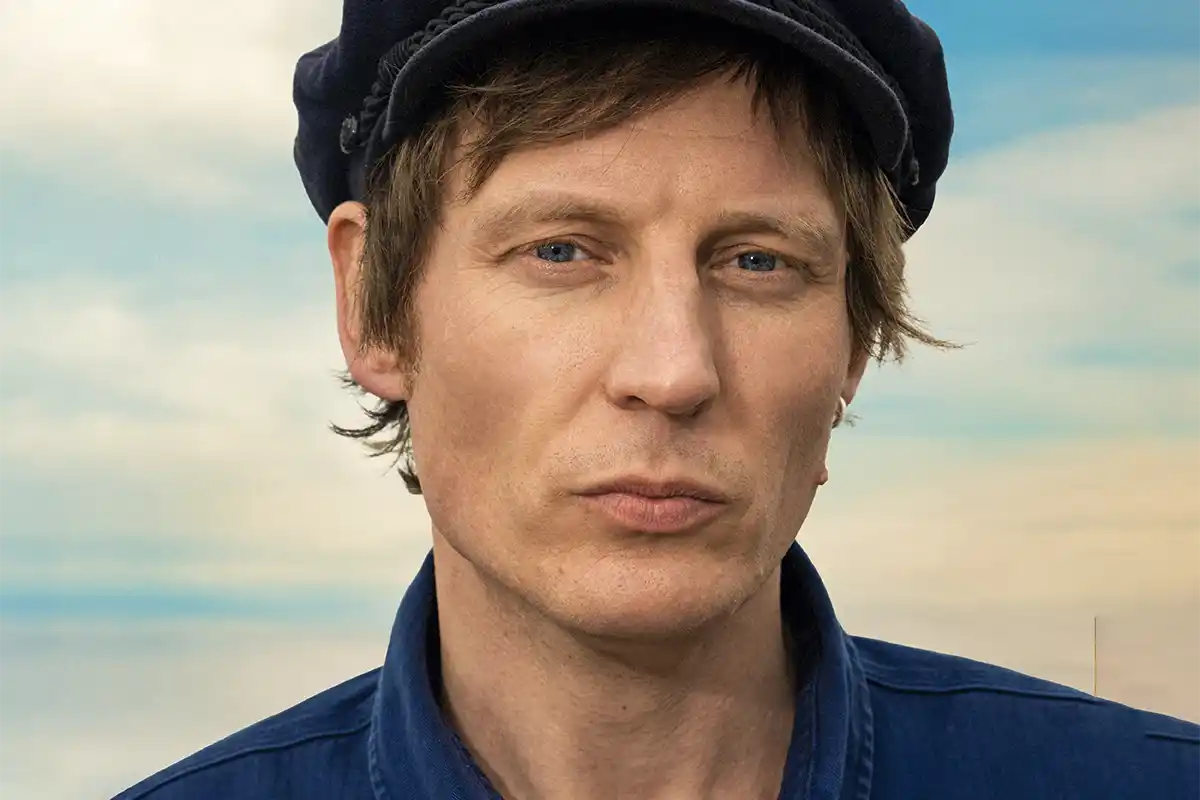
Lucky Fonz III is the exuberant stage name of Otto Wichers: a Dutch singer-songwriter and writer who stands out for a highly personal style. Whether for his lieds, retellings or libretto for The secret diary of Nora Plain to a composition by Morris Kliphuis, always you have the feeling you are dealing with an artist who makes somewhat vulnerable but direct contact with the listener. He won De Grote Prijs van Nederland for singer-songwriters and his album Celestial bodies was by NRC awarded Best Dutch album of the year 2022. In a broadcast of Podium Klassiek recently, Lucky talked about his musical heroes, his love of Schubert and preference for performing in small circles. Surely these are things we friends like to hear. On to a conversation!
I turn to the computer screen to connect via Zoom. Lucky turns out to have just moved to Rotterdam and proudly displays a beautiful sunny living room. It's immediately cosy, coffee on either side of the screen. I start by asking about his musical preferences. Finally noticed that the broadcast A good morning with Lucky Fonz of 8 March 2025 on NPO Classical offered such a colourful mix of musical styles. AND numerous vocalists: Aafje Heynis, Régine Crespin, Luciano Pavarotti, Tania Kross, Nora Fischer, Collegium Vocale Gent and Dietrich Fischer-Dieskau ...
Lucky: ‘In my childhood, everything mixed up. My father had a so-called broad taste in music and my mother listened a lot to pop music. Me and my two sisters could enjoy everything. For me as a toddler, Dietrich Fischer-Dieskau singing a lied by Schubert was just next to Johnny Cash with one of his songs. To me, they were both storytellers, but also characters in a story, embodying emotions. So to me, as a toddler, an aria or a lied was just as special as a pop song. Because for me, all of that was a form of individual musical communication that was dearest to me.
Categorising music into genres, it is a pity that it is often so limiting. Between pop and rock there is then overlap, but between pop and classical supposedly not. For myself, that's still not true; in my inner world, it all mixes together. My work as a singer-songwriter is influenced by Schubert. But surely that makes sense ... I think Schubert has more in common with Bob Dylan than Wagner!’
But Schubert didn't sketch his own lyrics like Dylan does, which is a big difference.
‘Is it a substantial difference? Schubert incorporates a lot of his own person and vulnerability into his musical compositions. You often feel he is very close to the lyrics he has chosen. Schubert, of course, had his liederen performed by others, while a singer-songwriter sings himself. That is a difference, but Schubert also sang his liederen sometimes and understood singers well, that's clear.
To be honest, I sometimes experience it as a problem that by singing my own lyrics, I am often identified with them for 100%. It's not necessarily about me alone. But in any case, it brings us more if we want to think about overlap rather than differences.’
That is also a message to our audience?
‘The passion and ecstasy can be very great when experiencing classical music, even though you are sitting still. You don't always have to seek that ecstasy by dancing the night away to music blaring through the speaker. If you like singer-songwriters, visit a liedrecital, I would say to my own audience. Liederences by Purcell still move as beautifully as they did 400 years ago. You see the big names of pop music from the 1950s and 1960s in concerts now, as more and more tribute bands emerge. These want to make everything sound exactly as it did then. So in performance practice, even pop music is now becoming a kind of classical music too. The time span between Richard Strauss and John Lennon, is now as wide as Lennon's to me. For me, that puts the distance from earlier music even more into perspective.
The individual expression of, for instance, John Lennon, when he was working as a solo artist, strongly influenced me. Schubert also inspires me. Because of the human feeling and his incredibly good setting of text. He expresses the content of the text through his music but is also a master of text placement, intelligibility, the sound texture of words in music. It has something very natural and supple while of course there had to be a negotiation between all the elements to be combined. The result is expressive and supple because he understands that negotiation so well.’
For the multidisciplinary performance Normality No More you have some liederen from Winterreise retranslated or substantially edited. Can you tell something about that performance?
‘Yes, the project was a collaboration between the Ragazze Quartet, dance company Conny Janssen Danst and theatre group Via Berlin, a number of lyricists and three singers. So it was not only my lyrics that could be heard in this performance. For Normality No More I wrote a few new texts and, indeed, retranslated poetry by Wilhelm Müller. The performance had the subtitle Winterreise revisited. There was very free with Winterreise handled hear, but Winterreise formed the guide to explore our inner world. Countertenor Arturo den Hartog sang beautifully Die Krähe while a dancer swirled around him searchingly, as it were representing that crow. The performance also sounded my retelling of Die Krähe, where I let a human search instead of the crow. I thought it made sense to represent the meaning of the performance in that way too.
I studied English but have also long had a love for German romance. The romantic tradition also suits me and my emotional disposition. But in this day and age, we have to watch out for images like, “my hot tears” and “your cold heart”, which have gradually become cliché of course.
If a text can go nicely hand in hand with the music, that's my ideal. Comprehensibility and something accessible, that's what I'm looking for.’
Lucky Fonz III will release his new album on 13 March. His new single Intergeneration is already available to listen to on YouTube. On his website, you can find more information, for instance the titles of his eight (!) previous albums and the dates and locations of a club tour, this spring and next autumn.
Francine van der Heijden
‘Little human’ (Normality No More)
Lyrics Lucky Fonz III, based on ‘Die Krähe’ (Winterreise) - Wilhelm Müller
Little human on the ground
You need not be sorrow-bound
For I have you on my eye
Black on black against the sky
Human! Godforsaken beast!
I will never leave you
Mindful!
How I dote upon you dear
Feed me what you're made of
Walk along and rest assured
You are only dreaming
All for want of melody
I will soon start screaming
All for want of melody
I will soon start screaming
| Cookie | Duration | Description |
|---|---|---|
| cookielawinfo-checkbox-analytics | 11 months | This cookie is set by GDPR Cookie Consent plugin. The cookie is used to store the user consent for the cookies in the category "Analytics". |
| cookielawinfo-checkbox-functional | 11 months | The cookie is set by GDPR cookie consent to record the user consent for the cookies in the category "Functional". |
| cookielawinfo-checkbox-necessary | 11 months | This cookie is set by GDPR Cookie Consent plugin. The cookies is used to store the user consent for the cookies in the category "Necessary". |
| cookielawinfo-checkbox-others | 11 months | This cookie is set by GDPR Cookie Consent plugin. The cookie is used to store the user consent for the cookies in the category "Other. |
| cookielawinfo-checkbox-performance | 11 months | This cookie is set by GDPR Cookie Consent plugin. The cookie is used to store the user consent for the cookies in the category "Performance". |
| viewed_cookie_policy | 11 months | The cookie is set by the GDPR Cookie Consent plugin and is used to store whether or not user has consented to the use of cookies. It does not store any personal data. |
 Dutch Dutch
  English Dutch Dutch English