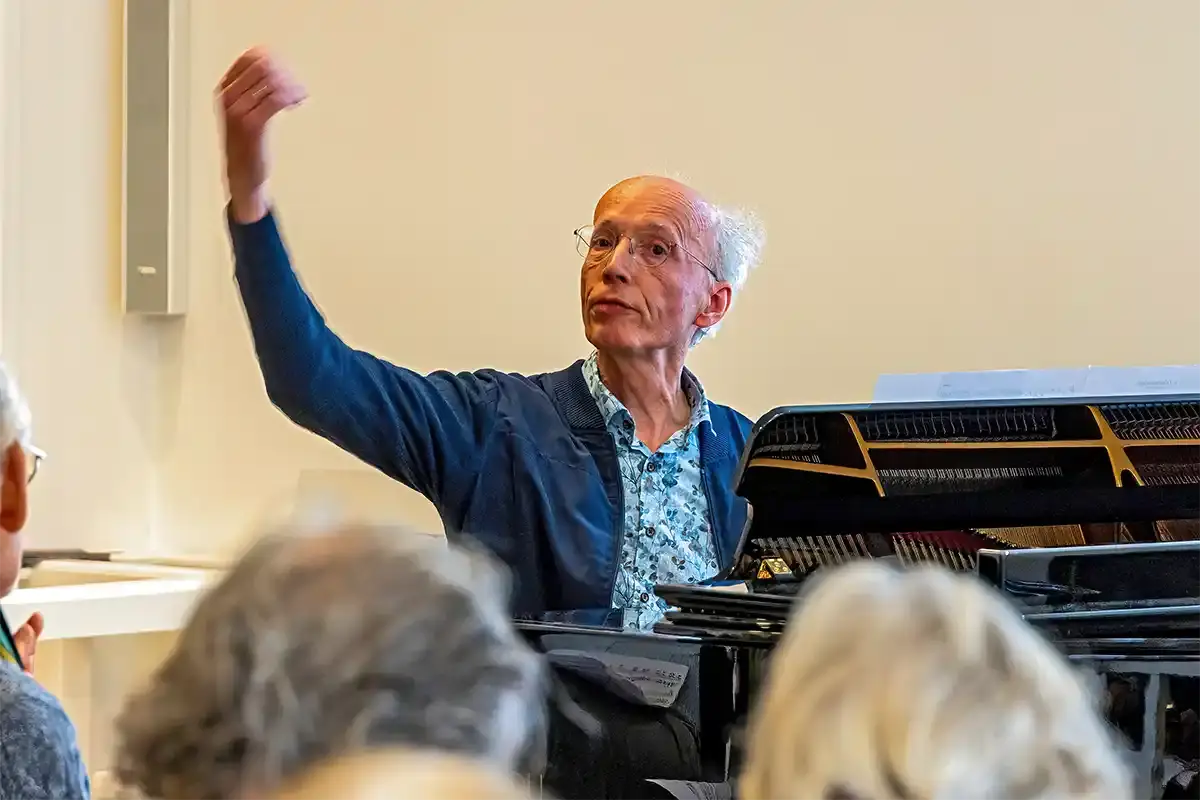
This year, Dinant took us on a journey through the notes and text of lied Feldeinsamkeit (Six Lieder for a lower voice op. 86 no. 2) by Johannes Brahms (1833-1897) to a poem by Hermann Allmers (1821-1902). The choice of lied Feldeinsamkeit fitted in nicely with the festival theme Back to Nature.
First of all, Dinant made it clear that there is a fundamental distinction between the two stanzas of the poem. In the first stanza, we find ourselves in the open field on earth with an impression of tall grass and crickets, but with our gaze directed upwards towards the sky (vertical). In the second stanza, we find ourselves among the white clouds in the deep azure of the sky and we float in infinity (horizontal). With Brahms, the two verses are clearly separated from each other, but musically closely connected. We find the vertical character at the beginning of the lied back in the ascending lines in both the piano accompaniment and the vocal part.
Allmers lets the cricket sounds be heard in line 3 with i/r sounds: crickets chirping, buzzing around. In stark contrast to this are the warm sounds of wondrously interwoven in line 4. In the third line of the second verse the reading pace stumbles due to the st-sounds in is, long sinceand died.
An essential building block of the music is the ticking time represented by the bass octaves with a dotted rhythm. From line 4, the dotted bass is not so prominent and in the repeated wondrously interwoven not at all, nor are there any eighth notes or repeating quarter-note chords. The music sounds timeless and soothing, fitting the warm tones of the poem. This also applies to the second verse. Alongside the passage of time, the long phrases in the vocal part and the quarter-note chords in the right hand of the piano part create a serene harmony with nature, while the simultaneous eighth-note movement in the same hand establishes the connection between heaven and earth.
With Brahms too, time stalls within the phrase It feels to me as though I died long ago. Here Dinant explained the falling motif that Brahms frequently uses when death or the grave is mentioned (a fine example of this is the second lied from the Four Serious Songs Op. 121.
Another important musical element is the rising chromaticism that Brahms uses in the vocal and piano parts. Something special happens with this in the second verse, because bar 22 is a semitone higher overall than bar 6. Through a subtle harmonic modification, Brahms imperceptibly transports the listener into another dimension.
At the grand piano, Dinant also reviewed various moments in the composition where Brahms musically illustrated the text; unfortunately, we cannot name them all. Dinant also let us hear two lovely recordings of lied, namely: a recording by Hermann Prey with Leonard Hokanson and a late recording by Elly Ameling with Rudolf Jansen. Particularly through this latter recording (granted, not a ‘tiefere stimme’), we were carried away into a beautifully serene and dreamy atmosphere that does justice to lied Feldeinsamkeit.
Finally, Dinant put in a good word for the poet Hermann Allmers, who is little appreciated nowadays. But without this poem, we would have to miss out on a very beautiful lied in the liedrepertoire! Naturally, the audience thanked Dinant for his lovely explanation of this wonderful lied and poem!
Guy Bischoff
member section Utrecht
| Cookie | Duration | Description |
|---|---|---|
| cookielawinfo-checkbox-analytics | 11 months | This cookie is set by GDPR Cookie Consent plugin. The cookie is used to store the user consent for the cookies in the category "Analytics". |
| cookielawinfo-checkbox-functional | 11 months | The cookie is set by GDPR cookie consent to record the user consent for the cookies in the category "Functional". |
| cookielawinfo-checkbox-necessary | 11 months | This cookie is set by GDPR Cookie Consent plugin. The cookies is used to store the user consent for the cookies in the category "Necessary". |
| cookielawinfo-checkbox-others | 11 months | This cookie is set by GDPR Cookie Consent plugin. The cookie is used to store the user consent for the cookies in the category "Other. |
| cookielawinfo-checkbox-performance | 11 months | This cookie is set by GDPR Cookie Consent plugin. The cookie is used to store the user consent for the cookies in the category "Performance". |
| viewed_cookie_policy | 11 months | The cookie is set by the GDPR Cookie Consent plugin and is used to store whether or not user has consented to the use of cookies. It does not store any personal data. |
 Dutch Dutch Dutch
  English Dutch Dutch Dutch English