What does music mean to you in everyday life?
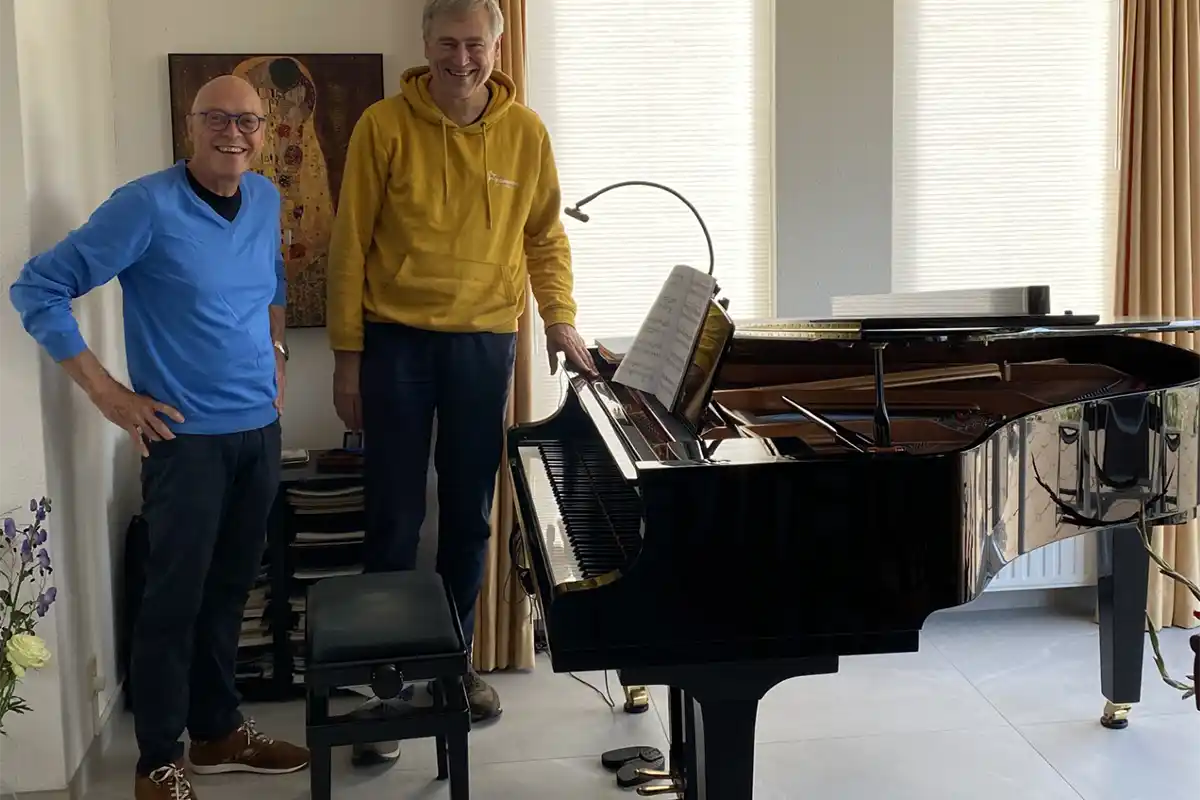
Frans: ‘For me, music is a daily source of breath, relaxation and closeness. Music relaxes and connects me to something beyond words.’
Henk: ‘For me as a pianist, music is a continuous voyage of discovery during which I am constantly amazed at how moods and emotions are captured in chords, turns of phrase, modulations and so on.’
Had you performed any of Benjamin Britten's work previously, or is this your first introduction to his music?
Frans: ‘No, I hadn't performed any work by Benjamin Britten before. This project is my first real introduction to his music, and therefore also an immediate voyage of discovery.’
Henk: ‘As a pianist, I have accompanied Britten's lied before and noticed how different the music can sound, sometimes romantic, sometimes almost like minimal music.’
Why does Benjamin Britten's lied appeal to you as a duo?
‘His lied are narrative, sometimes lightly ironic, sometimes touching, and that invites us to truly tell a story together with music and text. He also has surprising ways of conveying atmosphere in timbre and melody.’
How does singing or playing music by Benjamin Britten differ from singing or playing music by other composers?
Frans: ‘Britten challenges me to really look for it in the text and phrasing.’
What is harder: singing or playing the right notes, or conveying the right emotion?
‘The notes can also be very tricky, but once they have been mastered, there is the expression that needs to ring out.’
Why do you think Benjamin Britten's music still appeals to people today?
‘That will be down to the narrative aspect, the irony and the accessible melody.’
If someone is not yet familiar with Benjamin Britten, why should he or she come and listen to this open stage?
‘If you don't know Benjamin Britten yet, this open stage is the exact right place to get acquainted, and isn't it always wonderful to immerse yourself in music?’
If you could receive just one instruction from Benjamin Britten himself during a rehearsal, what would you hope he gave you?
Frans: ‘Then I hope he would talk about the expression as he intended it and how he conceived the emotional line through his music.’
Suppose Benjamin Britten himself were sitting in the auditorium on the 18th of October. What would the two of you like to tell him afterwards about your performance?
‘Something about the stories we heard and experienced in the lied.’
 Dutch
Dutch  English