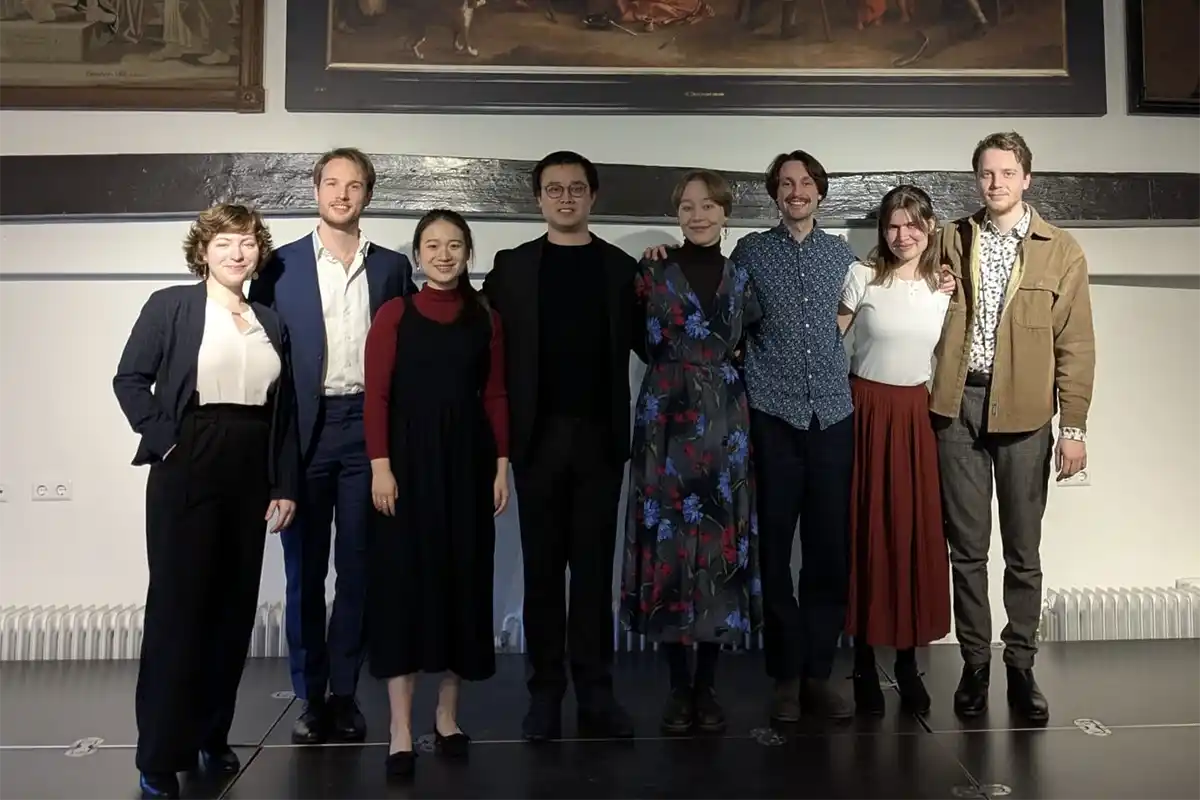
The musical arc takes the listener through a fragile emotional landscape: after the gold of a vibrant spring morning, immersed in the deep blue shadows of love’s sorrow, to finally invite them into the dark, theatrical underworld of the 20th century lied.
The journey begins in the Garden of Eden. In Heggies Snake is Eva confronted with temptation and forced to discover the true, sometimes harsh colours of the world. Smyth’s The Clown leads us deeper into the darkness of existence. Yet the work, even in the shadow, poses an essential question: can we find the lightness to keep dancing when our hands and feet are chained?
Next, we enter the brilliant light of the German lied. In Schubert's Ganymede does colour manifest in a warm, radiant glow that feels like love and nature close to one's heart. Strauss's’ Beating hearts enhances this mood with cheerful details: a golden sun, a shining ring and sparkling meadows sketch a sun-drenched landscape. Strauss's sparkling piano part and lively vocal line reflect the excitement of a young, loving heart, with the brilliance of the day reflecting the joy of living.
With their sights set on the south, Respighi's lied bring a completely different palette to the stage, bathing the hall in the warm, sun-drenched colours of the Tuscan countryside. In these two movements from Four Tuscan Respects do the rich, lyrical lines and lush piano part evoke the vibrant, golden hues of Italy. When you were born forms a radiant tribute to the dazzling beauty of a beloved, whilst It comes from far away paints a moving, pastoral picture of love and distance, imbued with an exhilarating Mediterranean warmth
As the daylight fades, a profound interplay of textures and shades emerges. Brahms’ The May Night depicts a nocturnal landscape in deep blue and dark green hues and the cold silver of the moon, thus capturing the melancholic colours of heartbreak. As a counterpart to this darkness, Barber introduces The Monk and His Cat the colour white: the white of the cat Pangur, the white of holy parchments. It is a colour of absolute purity, framing a simple, peaceful life bordering on the sacred.
The programme concludes in the smoky atmosphere of American lied. Bolcom's Song of Black Max introduces a mysterious, theatrical underworld surrounding Black Max: an enigmatic figure who is always dressed in black. Finally, Gershwin's classic Someone to Watch over Me The concert is imbued with a deep longing for comfort and emotional security. The piece, written as a jazz ballad full of ‘blue notes’, evokes the soft, comforting colors of the night.
| Cookie | Duration | Description |
|---|---|---|
| cookielawinfo-checkbox-analytics | 11 months | This cookie is set by GDPR Cookie Consent plugin. The cookie is used to store the user consent for the cookies in the category "Analytics". |
| cookielawinfo-checkbox-functional | 11 months | The cookie is set by GDPR cookie consent to record the user consent for the cookies in the category "Functional". |
| cookielawinfo-checkbox-necessary | 11 months | This cookie is set by GDPR Cookie Consent plugin. The cookies is used to store the user consent for the cookies in the category "Necessary". |
| cookielawinfo-checkbox-others | 11 months | This cookie is set by GDPR Cookie Consent plugin. The cookie is used to store the user consent for the cookies in the category "Other. |
| cookielawinfo-checkbox-performance | 11 months | This cookie is set by GDPR Cookie Consent plugin. The cookie is used to store the user consent for the cookies in the category "Performance". |
| viewed_cookie_policy | 11 months | The cookie is set by the GDPR Cookie Consent plugin and is used to store whether or not user has consented to the use of cookies. It does not store any personal data. |
 Dutch Dutch Dutch
  English Dutch Dutch Dutch English